Preface:
I wrote the inter-faith retreat below as an extra paper for the final class I took in the Summer of 2019 at Spring Hill College in Mobile, AL to fulfill the requirements for my Certificate in spiritual Direction. I sent it out to a few people to see if there might be some interest in it and so far, there is no interest expressed that this might be useful at this time. I am not surprised. I often come up with what some consider off the wall ideas or maybe some of the ideas are just a bit ahead of their time and may be useful later. At times like this, I just hang my ideas up on a peg on the wall for the future. My Blog site, http://www.jcooperforpeace.org is the peg on the wall from which I hang such matters. Lest one think me completely bonkers, I would like to point out a predicted inter-faith event that may happen, at least by principle sometime in the future. This year, the Feast of Tabernacles, (Sukkot to the Jews) will be observed from the evening of October 13th to the evening of October 20th, with what some observe to be the Last Great Day, or the 8th Day, to be observed on October 21st.
Zechariah 16-19:
16 Then all who survive of the nations that have come against Jerusalem shall go up year after year to worship the King, the LORD of hosts, and to keep the festival of booths. [49] 17 If any of the families of the earth do not go up to Jerusalem to worship the King, the LORD of hosts, there will be no rain upon them. 18 And if the family of Egypt do not go up and present themselves, then on them shall [50] come the plague that the LORD inflicts on the nations that do not go up to keep the festival of booths. [51] 19 Such shall be the punishment of Egypt and the punishment of all the nations that do not go up to keep the festival of booths. [52]
NRSV, Catholic Edition Bible, eBook . Thomas Nelson. Kindle Edition.
08/21/2019
John Cooper
Finding Peace in the World: An Interfaith Retreat for Muslims and Christians
Preparation and Instructions:
This retreat for finding peace in the world draws from the well of Ignatian Spirituality, modified for interfaith usage. Before taking this retreat, certain prerequisites are helpful. One prerequisite is to read and bring Finding Jesus among Muslims: how loving Islam makes me a better Catholic, by Jordan Denari Duffner, Liturgical Press, 2017, ISBN 9780814645925. Another is that you bring your own Qur’an and Bible with you to the retreat. Another prerequisite is that you ask Allah, God for the spiritual poverty to receive the grace of humility so your retreat will bear the spiritual fruits you desire. What is it you desire by attending this retreat? Please fill out the application to attend below. Additional handouts will be provided once you have registered to this retreat. It is recommended that if you are Christian, you attend one Islamic Friday Prayer Service, with the prior approval of the Prayer leader who may mention to you proper etiquette for attending. If you are Muslim, we recommend you attend one Christian worship service, preferably Roman Catholic, with prior approval and familiarity with the etiquette needed to attend.
Please print clearly
Last First Middle
Street City State Zip Code
Email Address _______________________________________Cell Phone_____ _____________
Cost of Retreat Is: __________________ Contact: __________________________ for payment.
- Past retreats: Briefly summarize all retreat experiences:
- Professional/Personal background: Briefly summarize your work history, ministry experience, and living situation.
- Intent: What do you hope to find or gain from this retreat experience?
Retreat Information: The Retreat for Peace in the World will be held at: ____________________________________________________________________________
On the dates of: ________________________________________________________________
This is a retreat of 4 days, Thursday night, all day and night on Friday, all day and night on Saturday, and ½ a day on Sunday. Please use no cellphones, or anything that makes noise. This is a silent retreat excepting for designated times of conversation. Parts of this retreat will be spent in just listening for God, Allah. Listen and silence are spelled with the same letters.
Formation and Preparation Days:
For your convenience please review the book annotation below in preparation for reading our textbook. You may wish to study the essay, Promoting Peace in the World: An Introduction to Living at Peace with the Other, and refer to the Bibliography for additional books to further your spiritual quest.
Book Annotation For: Finding Jesus among Muslims: how loving Islam makes me a better Catholic, by Jordan Denari Duffner, Liturgical Press, 2017, ISBN 9780814645925 (pbk).
Purpose: In Finding Jesus among Muslims: how loving Islam makes me a better Catholic, Jordan Denari Duffner discusses the experiences of interfaith dialogue helping her personally in three ways explained as threefold blessings of growing in friendship with Muslims, encountering God in Muslims, and the blessing of reconnecting herself to and deepening her own Catholic Faith.
Important Points:
Meeting God in Muslims: Duffner begins by discussing common ground she has experienced in relationship with Muslims. She mentions the important part Mary plays in both Catholic and Muslim traditions and Scriptures (pp. 15 & 16). She sees common ground in the good works individuals of both Faiths accomplish (p. 18). She recognizes the “’White Helmets’” who serve selflessly in the Syrian Civil War (p.20) and quotes the Quar’an, “”You will find the closest to the believers in affection to be those who say: ‘We are Christians,’ – the reason being that among them are priests and monks, and they are not a people given to arrogance” (5:82)” (p. 20). This accommodation of Christianity is crucial for us to keep in mind when we discover there are also differences between Christians and Muslims. The commonality of belief in one God, and God being a God who is Mercy is another commonality (pp. 21-26). Duffner also labels Islamophobia as a form of racism (p. 39) and challenges the Islamophobic assumption that Islam is inherently violent (p. 41). However, just as history has chronicled the fact that Muslims have gone to war, Duffner admits that Christianity, including her own Catholic Faith, “particularly Catholics,” she states, have done and are doing exactly the same, resorting to all kinds of violence throughout history, and in today’s world (p. 50).
Encountering God in Muslims: Duffner deeply appreciates Muslims’ five times per day prayer practices and sees the image of God in them, appreciating the loving and personal relationships she has with Muslims. (pp. 56, 57, etc.). She mentions that Nostra Aetate, a document of Vatican II, appreciates “what is good and true in other religions” (p. 57). Also important to her is that Islam has helped her more deeply encounter God in creation (p. 58). Islamic prayer practices have positively impacted her Faith (pp. 62, 63). Chapter 4 is titled, “The Width of a Hair.” She argues that our theological differences with Muslims are not really that great (p. 69). Quoting both Pope John Paul II and Pope Francis, she affirms that both Muslims and Christians worship the same God, are impacted by the same Holy Spirit, and that praying together is a good thing to do (pp. 70, 71).
Reembracing God in Christianity: Duffner explains how interreligious dialogue and seeing God in Muslims renewed her own Catholicism (p. 84). The salah, Muslims’ five times a day prayers, renewed her interest in the Ignatian Daily Examen prayer (p. 87, 88). “I grew to love my Catholic faith again” (p. 88). “I am not sure I could have remained within the fold of the Catholic Church if I had never encountered the church teaching on other religions formulated during Vatican II” (p. 91, 92). She thinks Muslims will be in heaven and a part of “The ‘communion of saints’” (p. 92, 93). Near the end of her book, Jordan Denari Duffner returns to her thesis, mentioning the “threefold blessing” acquired through dialogical relationships with Muslims, how we “encounter God” in in Muslims, and the blessing of being able to return to our own faith tradition reinvigorated and with “fresh eyes” (p. 108).
Application: Finding Jesus among Muslims broadens one’s mind to see those of other faiths as like us, created in the image of God. Duffner’s book is a foundational and needed insight for inter-religious dialogue. This book is a prerequisite for our retreat, Finding Peace in the World.
Recommendation: Whether or not one participates in the Finding Peace in the World retreat, all who are longing for peace in our world, and desire to view mankind as brothers and sisters and love each other as such brothers and sisters, should inculcate the heartfelt knowledge in this book into their lives.
Part I – The Blessing of Meeting God in the Other
Thursday Night: We will have greetings, fellowship, introductions, with snacks and beverages that are appropriate and culturally sensitive to Muslims, and Christians. Snacks will begin at 6 PM with a meal and conversation at 7 PM. We will check your customs, but generally no alcohol, no pork, shellfish, etc. will be provided. If we miss something, just don’t eat it if it is against your conscience.
Part II (A.) – The Blessing of Encountering God in the Other
Friday Morning: (Section AJ (Section B will be Sunday morning) Following breakfast at 8 AM, we will have a call to worship by our Muslim co-host: _____________________. An appropriate interfaith service lead by our Muslim co-host, _____________________ will occur. The rest of the day will be spent in silent prayer and reflection with the Noon meal in silence and the evening meal at 7 PM in silence. Silence in spiritual retreats is an Ignatian tradition. Prayer handouts with Qur’an and Bible verses for reflection will be given out for your assistance in preparing yourself for dialog.
Part III – The Blessing of Reembracing God in your Faith Tradition
Saturday: Breakfast with normal conversation will be at 8 AM. Our Muslim co-host will give a presentation on Islamic prayer practices, followed by our Christian co-host explaining Ignatian Prayer. Handouts on Muslim prayer and Examen prayer will be distributed. We will have Noon lunch with discussion then we will have small group breakout sessions discussing the handouts with Qur’an and Bible verses and reflection questions.
Promoting Peace in the World: An Introduction to Living at Peace with the Other
This summer, 2019, Spring Hill College in Mobile, AL[1] offered its Summer Institute of Spirituality[2] classes and I participated in SPT571/471 Spirituality of Inter-Religious Dialogue, taught by Dr. Matthew Bagot. The required text was Finding Jesus among Muslims: how loving Islam makes me a better Catholic, by Jordan Denari Duffner,[3] Liturgical Press, 2017. The class was modified for me to two credit hours which I need to complete my Certificate of Spiritual Direction (CSD) degree.[4] In preparation for this class I also read and/or referred to other books and articles listed in the Bibliography at the end of this essay.
Dr. Bagot and I agreed that for the additional one hour credit to make two total hours credit, I would write a three day retreat promoting inter-religious dialogue for Christians and Muslims using Finding Jesus among Muslims as the primary text, alluding to other recommended books I have read and refer to in the Bibliography. This research paper was to be ten to twelve pages, using Duffner’s thesis that “Interreligious dialogue allows us to grow closer to God in three ways: through the people we meet, through their religion, and through our own Christian faith.”[5]
I was attracted to this course particularly due to the linkage I recognized between Ignatian Spirituality, Duffner’s book, and Islamic thinking. This commonality of spiritual life is discussed by Duffner, “Noticing the strong faith community that my Muslim friends had, … I felt compelled to engage these aspects of my own faith tradition …Forms of prayer like the Daily Examen, devised by the founder of the Jesuit order of priests, St. Ignatius of Loyola, helped me to notice God more in my daily life.”[6] [7]
I set out to write an Ignatian style inter-religious retreat that both Muslims, Christians, and Jews could attend together in a common quest for Finding Peace in the World. I soon ran into a fork in the road, having exceeded my page limit and word limit, and I am now writing this document as an introduction to the retreat, Finding Peace in the World: An Interfaith Retreat for Muslims and Christians, which I will continue writing and post on my blog site[8] when it is finished. I plan to share the actual retreat with retreat houses and others who might like to find peace in the world through inter-religious dialog using a retreat format. In this introductory paper to that retreat I will expand on the spirituality of Duffner’s thesis and reexamine her thoughts in the lens of Ignatian Spirituality.
One of the features I appreciate about Jordan Denari Duffner’s writing style is the way she blends her life experience with her knowledge. This mix speaks to our common humanity and enlightens our soul as well as our mind. In Always Discerning, Joseph Tetlow, SJ quotes Richard of Chichester, “’O most merciful Redeemer, Friend, and Brother, may I know Thee more clearly, love Thee more dearly, and follow Thee more nearly, day by day.’”[9] It is this combination of knowledge, of love, and human interaction that speaks to the spiritual meaning of Duffner’s three part book. Part I is Meeting God in Muslims; Part II is Encountering God in Islam; and Part III is Reembracing God in Christianity. This combination of knowledge, love, and human interaction is a day by day task that also speaks to us in an eternal voice if we believe Muslims will be a part of the Communion of Saints. Duffner’s book is her personal testimony to knowing God in the eyes of the “other,” following God in the eyes of the “other,” and loving God in the eyes of the “other.” If we continue thinking like this book seems to hint at, maybe one day we will find there is really no “other” and that we are already in communion with each other and the One Divine Mystery, if we can only imagine it.
We must address the meaning of Islam itself. “Islam is the act of giving one’s self over to God, and aligning one’s own will with God’s; a Muslim is a person who willingly undertakes this act of devotion, and experiences the peace that comes with it.”[10] The heart of true spirituality is the giving up of the self, Kenosis, or self-emptying. It is this submission and giving of the self that creates peace that is often thought of when the word Islam is used. “Submission to God’s will is the sole basis of any authentic religion.”[11] This is why when we speak of Islam and speak of authentic spirituality we must at the same time speak of peace. Hence, the title of this essay is Promoting Peace in the World: An Introduction to Living at Peace with the Other and the title of the retreat I am writing is Finding Peace in the World: An Interfaith Retreat for Muslims and Christians.
If we are going to discuss the threefold blessings[12] of interfaith dialogue, we may ask, “What is this type of dialogue? “The Catholic Church teaches that interreligious dialogue is part of our vocation as Christians.”[13] Duffner mentions Pope John Paul II’s encouragement for each person to engage in this type of dialogue to further the mission of the church. God is in dialogue with humanity, the one God we commonly believe in and as Catholics view as One Trinitarian being is Himself in a dialogue of love, the Father, the Son, and the Holy Spirit. “The goal of dialogue, like the rest of our life, is to grow closer to God.”[14] Half of this dialogue is to listen, and half is to speak. The job of a Spiritual Companion is very much to listen. To be a spiritual companion with Muslims, in dialogue with them in prayer, in action, in worship, in life experience, and in eternity, is to fulfill our mission in life of drawing closer to God and sharing His love. It is Duffner’s goal to focus on this dialogue with Muslims, because that is Duffner’s personal experience, but the principles we discuss are applicable to other faiths, particularly to Abrahamic faiths.
Beginning with Part I of Finding Jesus among Muslims is Meeting God in Muslims. Normally when we meet someone for the first time, our focus is find some common ground. “Where are you from?” “What do you do for a living?” Finding common ground is fundamental to our task of meeting God in the “other.” From a Spiritual perspective, Christians, (especially Catholics) have much in common with Muslims (especially Shia Muslims). Surah Maryam is one of the longest surah’s in the Qur’an. The respect Muslims show for Mary and their devotion to her is a wonderful beginning point for finding, as Catholics, commonality with Muslims. The Spiritual Exercises of St. Ignatius is heavily laden with Marian prayer. When we think of Mary, perhaps in our Ignatian prayers of imagination, we might pick up the Qur’an and contemplate what Mohammad wrote about her. “The Qur’an speaks more of Jesus and Mary than of Muhammad, though less than of Abraham and Moses… He [Jesus] is called God’s word cast into Mary, and he is God’s spirit blown into her to effect Jesus’s fatherless conception.”[15]
Duffner also speaks of the commonality of good works, justice, and mercy that Christians and Muslims share. Mercy is crucial to Islam. When one meets a Muslim, one should meet Mercy. “In the Name of God, the Compassionate, the Merciful”[16] begins the surah of Maryam, and Mercy is mentioned at the beginning of every surah in the Quran but one.[17] From a spiritual point of view, what if when a Muslim meets a Christian, the Muslim should meet unconditional love? Would that this would happen in every case, then Mercy and Love would walk the face of the earth together.
1 In the Name of God, the Compassionate, the Merciful. 2 Praise be to God, Lord of the worlds, 3 the Compassionate, the Merciful, 4 Master of the Day of Judgment. 5 Thee we worship and from Thee we seek help. 6 Guide us upon the straight path, 7 the path of those whom Thou hast blessed, not of those who incur wrath, nor of those who are astray.[18]
When one reads the Qur’an, one ought to remember that everything the Qur’an says and means is prefaced with the presupposition of the Mercy of God. Reading the Qur’an with spiritual eyes means reading the Qur’an with eyes of Mercy, Allah’s Mercy. Even the “sword verse,” Qur’an 9:5 ends in Mercy.
Then, when the sacred months have passed, slay the idolaters wheresoever you find them, capture them, besiege them, and lie in wait for them at every place of ambush. But if they repent, and perform the prayer and give the alms, then let them go their way. Truly God is Forgiving, Merciful.[19]
We Christians have our own difficult Scriptures and “sword” verses too which should be tempered in God’s final Love, Mercy, and Grace.
In the process of expanding more on the Spirituality of the threefold blessings of interfaith dialogue in growing closer to God though meeting God in Muslims, through their religion, and reembracing our own Faith in God,[20] Duffner gives us her viewpoint on meeting the Image of God in Muslims. Here is where we run into a little difficulty concerning God’s Image in Muslims. Duffner fully believes God’s Image is in Muslims, “I have encountered God’s image and spirit in Muslims countless times.”[21] I fully agree with her and for that matter, I believe God’s Image is in every human. Ignatian Spirituality asks us to find God in all things.[22]
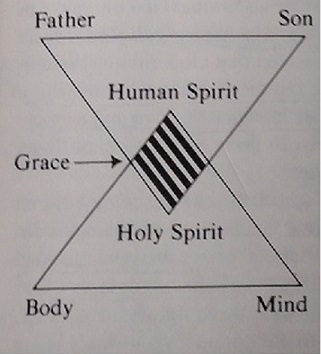
[23]
The graphic above speaks to my personal view of the spirituality of God’s Image being in man. This is the Eastern view, but others, even in the Catholic Church have a viewpoint of God being absolutely transcendent, as do most Muslims, to my knowledge. “Naught is like unto Him (cf. 112:4) is among the most famous phrases of the Quran, as it provides a succinct and unequivocal assertion of God’s complete and utter transcendence (tanzīh). Like unto Him renders ka mithlihi, which literally reads “like His likeness.””[24] I confirmed my inclinations that Muslims would not agree that the image of God is in us, with one of my Muslim friends, yet he explained God as being Omniscient, Omnipotent, and Omnipresent. I suggested that if God were omnipresent, He could be present in us too. The apostle Paul, speaking to the Greek intellectuals from whom some of our Western ideas about God come, stated, “From one ancestor [140] he made all nations to inhabit the whole earth, and he allotted the times of their existence and the boundaries of the places where they would live, 27 so that they would search for God [141] and perhaps grope for him and find him—though indeed he is not far from each one of us. 28 For ‘In him we live and move and have our being’; as even some of your own poets have said, ‘For we too are his offspring.’”[25] He understood. For a more detailed viewpoint on this matter see Quran 50:16 “We did indeed create man, and We know what his soul whispers to him; and We are nearer to him than his jugular vein.”[26][27]
My friend, Mirza, may not agree about God’s Image being in mankind, but he did agree with me and would agree with Duffner about God’s Spirit being in mankind. See Qur’an 15:28:
“And [remember] when thy Lord said unto the angels, “Behold! I am creating a human being from dried clay, made of molded mud; 29 so when I have proportioned him and breathed into him of My Spirit, fall down before him prostrating.”[28]
The Qur’an is full of references to the Holy Spirit. The Holy Spirit is a key area of commonality for experiencing the Spirituality of finding Jesus among Muslims.
We have viewed the Spiritual Blessings of interreligious dialogue with individual Muslims. This discussion has drawn us closer to God in many experiential ways. Examining Part II of Finding Jesus among Muslims, let us consider how we encounter God in the religion of Islam. Can the religion itself help us grow closer to God? When I grew up in the Roman Catholic Church I heard that the Catholic Church is the one and only true Church. Subconsciously I think I realized some problems with that way of thinking, and for matters of conscience regarding war and the Sabbath, I left the Catholic Church at about twenty years old for another one and only true Church that I felt I was being called to join. That is a little humorous, looking back at it now, but before too late I realized that God is at work in the whole world and in people of different religions. I did not know in 1969 that in 1965, Vatican II, in the fourth draft of Nostra Aetate addressed certain issues that are relevant to my concerns then and our discussion today.
The Church regards Muslims with esteem: they adore the one God, living and enduring, the all-powerful Creator of heaven and earth who has spoken to people; they strive to obey wholeheartedly His inscrutable decrees, just as Abraham did, to whose faith they happily link their own. <break> Furthermore, as they worship God through prayer, almsgiving, and fasting, so they seek to make the moral life—be it that of the individual or that of the family and society—conform to His Will.[29]
Duffner mentions a similar passage on p. 57. Vatican II contains clear breaks from prior Catholic teachings that for many, such as myself, who returned to the Catholic Church after many years, find refreshing and Spirit led. Signs of this Spirit, signs of God, are called ayat in the Qur’an. Duffner quotes the Qur’an regarding these signs of God in nature, in the birds of the air, the rain, the cattle, crops, and in humans.[30] We have already mentioned how well this viewpoint of seeing God in all things fits into Ignatian Spirituality. In some mysterious way, God is everywhere, in all things, in all humans, and even in all religions! Duffner quotes Pope Francis, “’The universe unfolds in God, who fills it completely. Hence there is a mystical meaning to be found in a leaf, in a mountain trail, in a dewdrop, in a poor person’s face.’”[31] Pope Francis was finding his inspiration from a sixteenth century Muslim mystic, Ali al-Khawas.
What a breath of fresh air has overcome the sometimes stale winds which the Spirit needs sometimes to stir up in our own religion. The Spirituality of the “other,” the Spirituality of the other’s religion, can sometimes help overcome legalistic hurdles set into our minds. Thank God Pope Francis,[32] a Jesuit, schooled in Ignatian Spirituality, can accept these winds and speak like this. I have thought several times as I write to mention how some of this spirituality fits into the beliefs of St. Francis. Duffner mentions this association on pages 62 and 63, suggesting that some believe that St. Francis, while on a peace mission to sultan Malik al-Kamil in the thirteenth century, well before St. Ignatius, may have drawn inspiration for some of his prayers from Muslim sources.[33]
This brings up the concept of praying together. We all live on the same earth, breathe the same air, and eat the same food. Can we all pray together? I think a prerequisite for Spirituality is humility. I have most of my life been much too proud and conceited, and probably in my best state, I am still so. While taking the 19th Annotation of the Spiritual Exercises of St. Ignatius about five years ago or so, I latched on to the Ignatian Spirituality idea of giving up everything to live only in the love and grace of God and started to tell others about it. Before too long I ended up being wrung through the wringer, suffering a business bankruptcy, and getting relieved of some of that pride and conceit. Duffner’s chapter 4, The Width of a Hair, is now my spiritual view of what I know about things and what I believe all religions know about God. If all mankind, and all religions were run through a wringer, stirred up in a washtub, and spilt into the ocean, our knowledge, and all we are so proud of, is just a drop in the ocean to what God knows, how much God loves, and how Merciful God is. Duffner speaks to my idea under the heading “’The One and Merciful God.’”[34]
Duffner quotes Pope St. John Paul II’s 1985 address to Muslim youth in Morocco, “’We believe in the same God, the one God, the living God, the God who created the world and brings his creatures to their perfection.’”[35] From a spiritual point of view, isn’t this and other quotes from Pope Francis[36] in a similar vein refreshing? What is so refreshing about it from a spiritual point of view is that if we believe these things, we relieve ourselves of our disordinate affections, giving up ourselves, emptying ourselves, of vanity, conceit and pride. St. Ignatius often warned of the evils of riches, honor, and pride. How much better off eternally would we be if we could rid ourselves of such evils?
We must now address the last section of Duffner’s book, and address how the spirituality of inter-religious dialogue has, or is going to help us reembrace our own Faith tradition. When I left the Catholic Church, I did not leave Christianity. Other Christians besides Catholics have God’s Holy Spirit too. The Spirit is an indelible sign of God’s Presence. It is a wind that blows where it will. Eventually with the election of Pope Francis, I began to reexamine my relationship to the Catholic Church. Here is a man who thinks like St. Francis, I thought. Pope Francis is a part of my reexamination, the 19th Annotation is another part, and the Holy Spirit is the elephant in the room concerning why I came back to the Catholic Church. I believe I needed to be set free to think like we are thinking right now. The world is a big place, the Catholic Church is a big place, and Islam is a big place. Nothing is always perfect, always right, always the one, true and only thing to consider, but spiritually, let us consider how big God is. God is GREAT!
Perhaps Jordan Denari Duffner and Finding Jesus among Muslims has brought you to reexamine your thinking about your own Faith. Perhaps just reading this essay has motivated you to reexamine some things you thought you believed. Maybe something spiritual has touched you. I hope so. This is the reason I have written this essay, to expand on the spirituality of Duffner’s book and view it through the lens of Ignatian Spirituality. Duffner explains how her interreligious dialog touched her inner being and brought her back to the Daily Examen,[37] an Ignatian form of prayer.[38] She says, “St. Ignatius of Loyola, helped me to notice God more in my daily life. I developed a deep personal friendship with Jesus, who became a companion to me…”[39]
Duffner looks back to over fifty years ago, to a crown jewel of her Catholicism, Vatican II. She quotes Lumen Gentium, “But the plan of salvation also includes those who acknowledge the Creator, first among whom are the [Muslims]: they profess to hold the faith of Abraham, and together with us adore the one, merciful God…”[40] She also mentions the essential dogma of Lumen Gentium that one must live by one’s conscience. She mentions another Catholic term, the “communion of saints” and her heart’s desire is that heaven is full of Muslims.
Essential common ground we share with Muslims is the constant reexamination of our “self.” This is another spiritual aspect of our discussion. “Muslims share with Catholics the foundational, basic parts of the spiritual life, things like a constant returning to God through prayer, and an emphasis on trust in God.”[41] The emptying of toxic self is essential to giving up everything to live only in God’s love and grace. This surrender is the root, s-l-m in Islam and Muslim, the surrender of giving up the self and our own selfish will to the One, true God, to enter this Divine and Mystical union, to continue living in Eternity, in communion with Him, and one another. This surrender brings us peace. “’I am no longer legitimizing the violence that has been done toward the other group…I take on the responsibility of what has happened in the past from my own group, what my group has inflicted.’”[42] Therefore we return to the title of this essay, Promoting Peace in the World: An Introduction to Living at Peace with the Other. Will you join us in communion to experience the spirituality of our quest to enter dialogue and experience this peace with God and each other, in combination with the knowledge we now have about what we should be doing in this life and the next?
John Cooper
Bibliography:
- Finding Jesus among Muslims: how loving Islam makes me a better Catholic, by Jordan Denari Duffner, Liturgical Press, 2017. ISBN 9780814645925
- American Islamophobia: understanding the roots and rise of fear, by Khaled A. Beydoun, University of California Press, 2018, ISBN 9780520970007
- Islam and Christianity: theological themes in comparative perspective, by John Renard, University of California Press, 2011 ISBN 978-0-520-26678-0
- Peace Primer, Quotes from Islamic & Christian Scripture & Tradition, edited by Ken Sehested and Rabia Terri Harris, co-published by Muslim Peace Fellwoship & Baptist Peace Fellowship, 2002 (pamphlet)
- Common Ground: Islam, Christianity, and religious pluralism, by Paul Heck, Georgetown University Press, 2009, ISBN 978-1-58901-507-4
- Orientalism, by Edward W. Said, Penguin Classics, 2003, ISBN 978-0-141-18742-6
- The Qur’an: a new translation, by M.A.S. Abdel Haleem, Oxford University Press, 2010, ISBN 978-0-19-95395-8
- The Go-Anywhere Thinline Bible Catholic Edition, Harper Collins Publisher, 2010
- Several articles, Ignatius of Loyola: Apostle to the Muslims, by Damian Howard, SJ; What is the Koran?, by Roby Lester, Jesus in the Quran: Pious, Obedient, Favored Servant of God, by Francis X. Clooney, SJ; Islam and Ignatian Spirituality, by Renato Oliveros, PHD; ‘The Study Quran’ and the Battle against Ignorance, by Francis X Clooney, SJ; On Pluralism, Intolerance, and the Quran, by Ali S. Asani, How to Read the Qur’an, by Ingrid Mattson; and The Human in the Qur’an, by Renovatio.
Discussion leaders will be chosen, and participants counted out, 1, 2, 3, 4, etc., with 1’s, 2’s, 3’s, 4’s going into separate groups. Discussion guidelines are below:
Discussion Guidelines:
Discussions go better when each person:
- Respects the value of everyone’s observations or insights.
- Allows everyone the opportunity to speak, if they so choose.
- Focuses the discussion on the topic being discussed.
- Share freely, but refrains from correcting or giving advice.
- Keeps all personal sharing confidential.
- Puts unanswered questions on the future study list.
After discussions in small groups, everyone will gather again with the small group leader sharing one or two significant insights. Then, dinner at 7 PM with additional conversation.
Part II (B.) – Continuing the Blessing of Encountering God in the Other
Sunday: (Section BJ (Conclusion of Friday morning’s session) Breakfast with discussion will be at 8 AM.
Christian Mass at 10 AM. (Remember the customs of the other; for instance, during Communion, Catholics believe in the Real Presence in the Eucharist, so those who do not believe this will want to go up too, with their arms crossed, to receive a blessing in place of the Eucharist.)
At 11:30 – Group pictures will be taken, farewells and appropriate expressions of affection will be exchanged.
Handouts
Notations:[43]
Finding Peace with Difficult Passages
It will be helpful right from the start to acknowledge we must accept the other right where they are. Faith traditions have different Scriptures and we will never agree on everything. We are seeking common ground for our spiritual journey. Within the Muslim Faith are numerous divisions, Sunni’s, Shia, Sufi’s, just to name a few. Within the Christian Faith there are also numerous divisions, Catholic, Protestant, Non-Denominational, Orthodox, just to name a few. In all the divisions we find various hermeneutical methods. Finding Peace in the world is not about finding complete agreement on every detail, but finding peace in the world in a spiritual sense is about seeking union with the One, Divine, and Mysterious God together by seeking common ground. That being said, let’s begin our quest by examining some difficult to understand passages.
Notes:
……………………………………………………………………………………………………………………………………………………………………………………………………………………………………………………………………………………………………………………………………………………………………………………………………………………………………………………………………………………………………………………………………………………………………………………………………………………………………………………………………………………………………………………………………………………………………………………………………………………………………………………………………………………………………………………………………………………………………………………………………………………………………………………………………………………………………………………………………………………………………………………………………………………………………………………………………………………………………………………………………….
I am Aware:
1.) Everything must be understood in context.
2.) Often I do not know the historical context.
3.) I must see everything through spiritual eyes.
Praying Today:
Scripture: Qur’an: Repentance Surah 9
5 … Slay he idolaters…capture them, besiege them, and lie in wait for them at every place of ambush. …. 6 …Then convey him to his place of safety. That is because they are a people who know not.[44] (Read in context.)
Scripture: Bible: 1 Samuel 15
3 Now go and attack Amalek, and utterly destroy all that they have; do not spare them, but kill both man and woman, child and infant, ox and sheep, camel and donkey.’” (Read in context.)
Scripture: Bible: Revelation 2:12, 16
12 “And to the angel of the church in Pergamum write: These are the words of him who has the sharp two-edged sword: …16 Repent then. If not, I will come to you soon and make war against them with the sword of my mouth. [45]
Finding Peace in the World
With Difficult Scriptures
Grace to Ask:
May I find Peace with people and Scriptures I do not understand?
I am thinking this today:
………………………………………………………………………………………………………………………………………………………………………………………………
“Just” Thinking:
Honest differences are often a healthy sign of progress
– Mahatma Gandhi
Finding Peace with Mercy
What do you want? Do you want peace in the world? Do you want peace in your life? Do you want peace with justice? How much justice? Is it “just” justice for you and your family? Would it be “just” if everyone got what they deserved, finally? Well, what about you own sin? Do you want to pay for your own sins? Wouldn’t it be “just” if you paid for your own sins? Can you think of when it was you first sinned? Was stealing a cookie out of a cookie jar your first sin? What was it? Did you continue to sin? How about when you were a teenager? Did you have any improper sexual thoughts our actions? Have you paid for them yet? If there is such a state as Purgatory, do you look forward to paying for all your sins? What about the sins of your ancestors? Would you like to pay for those sins? Would you like to pay for the sins of the Catholic Church during the Crusades? Would you like to pay for the sins of your nation? Should we give back the land to the American Indians, or Palestine to the Palestinians? How far would you like to take this matter? To your grave? After you are dead? Mohammad and Jesus talked a lot about Mercy. Every surah but one begins with “In the name of God, the Entirely Merciful, the Always Merciful.” Jesus (Isa) was regularly getting in trouble about giving out Mercy instead of sticking to the law. Where the love of God is, no law is needed. Maybe you would rather be under some kind of law. You decide. You think about it… Are you at peace with mercy? Mercy for yourself” How about Mercy for everybody?
Notes:
……………………………………………………………………………………………………………………………………………………………………………………………………………………………………………………………………………………………………………………………………………………………………………………………………………………………………………………………………………………………………………………………………………………………………………………………………………………………………………………………………………………………………………………………………………………………………………………………………………………………………………………………………………………………………………………………………….
I am Aware:
1.) I am a sinner.
2.) I am a sinner loved by God.
3.) God is so merciful to me!
Praying Today:
Scripture: Qur’an: Qur’an 1:1-3
1 In the Name of God, the Compassionate, the Merciful. 2 Praise be to God, Lord of the worlds, 3 the Compassionate, the Merciful,
Scripture: Bible: Matthew 23
23 “Woe to you, scribes and Pharisees, hypocrites! For you tithe mint, dill, and cummin, and have neglected the weightier matters of the law: justice and mercy and faith. It is these you ought to have practiced without neglecting the others. 24 You blind guides! You strain out a gnat but swallow a camel!
Scripture: Bible: I Peter 2: 10:
10 Once you were not a people, but now you are God’s people; once you had not received mercy, but now you have received mercy.
Finding Peace in the World
With the Merciful
Grace to Ask:
May I find mercy and peace in the world?
______________________
I am thinking this today:
………………………………………………………………………………………………………………………………………………………………………………………………………………………………
“Just” Thinking:
“Be like the sun for grace and mercy. Be like the night to cover others’ faults. Be like running water for generosity. Be like death for rage and anger. Be like the Earth for modesty. Appear as you are. Be as you appear.” (Rumi)
Finding Peace with Love
Which came first, the chicken or the egg? Sometimes we wonder if we must perform well, obey our fathers and our mothers first, then they will love us. Or, obey God’s will for our lives, then God will love us. There are passages in the Bible and in the Qur’an which could be argued either way, but I think God’s love always comes first. After all, “Mercy has also been a main topic in treatises of Muslim thinkers and poets throughout history, like the medieval philosopher Ibn Arabi, who wrote that God “mercified’ the universe into being.”[46] Did God know our spirits from before we were born? Did He know our spirits from eternity? Could he have put our being, our mind and spirit, our soul, into a different body? Would you like a body that is taller, or shorter, or a skin that is not so dark, or not so light? Would you like to have a mind that is more intelligent? Would you like a body that is not sick sometimes? God could have done it, but he didn’t, because God loves you just like you are. Of course, we want to respond, to love Him back, and to love others too, just as He asked us to do, but, really, didn’t God love us first?
Notes:
……………………………………………………………………………………………………………………………………………………………………………………………………………………………………………………………………………………………………………………………………………………………………………………………………………………………………………………………………………………………………………………………………………………………………………………………………………………………………………………………………………………………………………………………………………………………………………………………………………………………………………………………………………………………………………………………………………………………………………………………………………………………………………………………………………………………………………………………………………………………………………………………………………………………………………………………………………………………………………………………………………………………………………………………………………………………………………………………………………………………………………………………………………………………………………………………………………………………………………………………………………………………………………………………………………………………………………………………………………………………………………………………………….
I am Aware:
1.) God’s Spirit may cause love to arise in my soul.
2.) Allah will always love me.
3.) My parents loved, or love me.
Praying Today:
Scripture: Bible: 1 John 1:7
7 Beloved, let us love one another, because love is from God; everyone who loves is born of God and knows God. 8 Whoever does not love does not know God, for God is love.
Scripture: Qur’an: 3:31
31 Say, “If you love God, follow me, and God will love you and forgive you your sins. And God is Forgiving, Merciful.”
Scripture: Bible: 1 John 1:7
15 “If you love me, you will keep [121] my commandments. 16 And I will ask the Father, and he will give you another Advocate, [122] to be with you forever.
Finding Peace in the World with Love
Grace to Ask:
May I find Love and Peace in the world?
I am thinking this today:
………………………………………………………………………………………………………………………………………………………………………………………………
“Just” Thinking:
Day by day, dear Lord, of thee three things I pray: to see thee more clearly, love thee more dearly, follow thee more nearly, day by day.
– Richard of Chichester
How can we continue to Find Peace in our World?
We have covered all we can during our four day retreat. Have we done anything to change our world? Perhaps we have merely begun a process. Perhaps we have received special blessings as a result of our participation. I have some suggestions for continuing this retreat for Peace in daily life. Let us found our lives on prayer. Let us explore other ways to pray, such as the daily Examen or the prayer of Moses. Living our lives in balance is also crucial. We must work, take care of or families, and do charitable deeds to live our lives in balance. Whether we are Muslim or Christian, the Spirit is crucial to our lives and we should take time to recognize we are not alone. God is with us. God is everywhere. Maybe ten minutes a day could be spent in silence to listen to God. Maybe while driving we could occasionally turn off the radio and contemplate how good Allah has been to us. Maybe we can find a special place to pray.
Here are some of my suggestions for continuing as a group and multiplying our efforts to promote peace in the world and make a difference. Let’s have a live internet conference once per month using Google Meet. In this conference each of us can take turns adding to this retreat by writing additional handout pages using the format I have above. The last two pages are a template for doing this. Think of your own ideas, but in the next column are some ideas to consider. Before long we will have a whole retreat book, if we just do one topic a month. Then we can get the book published and share it with others. That can make a difference in the world.
Suggested Topics:
Finding Peace in the World with the Spirit.
Finding Peace in the World with Isa (Jesus.)
Finding Peace in the World with the Kingdom.
Finding Peace in the World with Kindness.
Finding Peace in the World with Dialogue.
Finding Peace in the World with Truth.
Finding Peace in the World with Prayer.
Finding Peace in the World with Knowledge.
Now you have the general idea. Let’s work together for Peace in the world one person at a time. What the world needs now is Peace in the world!
Blessings!
John Cooper
Tuscaloosa, AL
Finding Peace with _________________
XXXXXXXXXXXXXXXXXXXXXXXXXXXXXXXXXXXXXXXXXXXXXXXXXXXXXXXXXXXXXXXXXXXXXXXXXXXXXXXXXXXXXXXXXXXXXXXXXXXXXXXXXXXXXXXXXXXXXXXXXXXXXXXXXXXXXXXXXXXXXXXXXXXXXXXXXXXXXXXXXXXXXXXXXXXXXXXXXXXXXXXXXXXXXXXXXXXXXXXXXXXXXXXXXXXXXXXXXXXXXXXXXXXXXXXXXXXXXXXXXXXXXXXXXXXXXXXXXXXXXXXXXXXXXXXXXXXXXXXXXXXXXXXXXXXXXXXXXXXXXXXXXXXXXXXXXXXXXXXXXXXXXXXXXXXXXXXXXXXXXXXXXXXXXXXXXXXXXXXXXXXXXXXXXXXXXXXXXXXXXXXXXXXXXXXXXXXXXXXXXXXXXXXXXXXXXXXXXXXXXXXXXXXXXXXXXXXXXXXXXXXXXXXXXXXXXXXXXXXXXXXXXXXXXXXXXXXXXXXXXXXXXXXXXXXXXXXXXXXXXXXXXXXXXXXXXXXXXXXXXXXXXXXXXXXXXXXXXXXXXXXXXXXXXXXXXXXXXXXXXXXXXXXXXXXXXXXXXXXXXXXXXXXXXXXXXXXXXXXXXXXXXXXXXXXXXXXXXXXXXXXXXXXXXXXXXXXXXXXXXXXXXXXXXXXXXXXXXXXXXXXXXXXXXXXXXXXXXXXXXXXXXXXXXXXXXXXXXXXXXXXXXXXXXXXXXXXXXXX
Notes:
……………………………………………………………………………………………………………………………………………………………………………………………………………………………………………………………………………………………………………………………………………………………………………………………………………………………………………………………………………………………………………………………………….
I am Aware:__________________
1.)
2.)
3.)
Praying Today:
Scripture: Qur’an:
Scripture: Bible:
Finding Peace in the World
With _______________
Grace to Ask: __________
______________________
______________________
I am thinking this today:
………………………………………………………………………………………………………………………………………………………………………………………………
“Just” Thinking:
………………………………………………………………………………………………………………………………
Finding Peace with _______________
XXXXXXXXXXXXXXXXXXXXXXXXXXXXXXXXXXXXXXXXXXXXXXXXXXXXXXXXXXXXXXXXXXXXXXXXXXXXXXXXXXXXXXXXXXXXXXXXXXXXXXXXXXXXXXXXXXXXXXXXXXXXXXXXXXXXXXXXXXXXXXXXXXXXXXXXXXXXXXXXXXXXXXXXXXXXXXXXXXXXXXXXXXXXXXXXXXXXXXXXXXXXXXXXXXXXXXXXXXXXXXXXXXXXXXXXXXXXXXXXXXXXXXXXXXXXXXXXXXXXXXXXXXXXXXXXXXXXXXXXXXXXXXXXXXXXXXXXXXXXXXXXXXXXXXXXXXXXXXXXXXXXXXXXXXXXXXXXXXXXXXXXXXXXXXXXXXXXXXXXXXXXXXXXXXXXXXXXXXXXXXXXXXXXXXXXXXXXXXXXXXXXXXXXXXXXXXXXXXXXXXXXXXXXXXXXXXXXXXXXXXXXXXXXXXXXXXXXXXXXXXXXXXXXXXXXXXXXXXXXXXXXXXXXXXXXXXXXXXXXXXXXXXXXXXXXXXXXXXXXXXXXXXXXXXXXXXXXXXXXXXXXXXXXXXXXXXXXXXXXXXXXXXXXXXXXXXXXXXXXXXXXXXXXXXXXXXXXXXXXXXXXXXXXXXXXXXXXXXXXXXXXXXXXXXXXXXXXXXXXXXXXXXXXXXXXXXXXXXXXXXXXXXXXXXXXXXXXXXXXXXXXXXXXXXXXXXXXXXXXXXXXXXXXXXXXXXXXXXX
Notes:
……………………………………………………………………………………………………………………………………………………………………………………………………………………………………………………………………………………………………………………………………………………………………………………………………………………………………………………………………………………………………………………………………….
I am Aware:__________________
1.)
2.)
3.)
Praying Today:
Scripture: Qur’an:
Scripture: Bible:
Finding Peace in the World
_______________________
Grace to Ask: __________
______________________
______________________
I am thinking this today:
………………………………………………………………………………………………………………………………………………………………………………………………
“Just” Thinking:
………………………………………………………………………………………………………………………………
[1] https://www.shc.edu/
[2] http://departments2.shc.edu/graduatetheology/summer-institute
[3] See Denari Explain book at: https://www.facebook.com/ReligionNewsSvc/videos/jordan-denari-duffner-on-finding-jesus-among-muslims/10155409024697799/
[4] http://departments2.shc.edu/graduatetheology/spiritualdirection
[5] Finding Jesus among Muslims: how loving Islam makes me a better Catholic, by Jordan Denari Duffner, Liturgical Press, 2017, ISBN 9780814645925, p. 7.
[6] Ibid., p. 88
[7] See Ignatius of Loyola: Apostle to the Muslims, by Damian Howard, SJ and Islam and Ignatian Spirituality, by Renato Oliveros, PHD referenced in the Bibliography for further development of the Ignatian and Islamic spiritual connections.
[8] http://www.jcooperforpeace.org
[9] Always Discerning: An Ignatian Spirituality for the New Millennium, Joseph A. Tetlow, SJ, Loyola Press, 2016, ISBN-13 978-0-08294-4456-8, p. 75
[10] Duffner, p. xi
[11]Islam and Ignatian Spirituality, by Renato Oliveros, PHD, p. 4
[12] One may also want to reexamine what one means by “blessing.” See: https://en.wikipedia.org/wiki/Blessing
[13] Duffner, p. 3.
[14] Ibid, p. 4.
[15] Common Ground: Islam, Christianity, and religious pluralism, by Paul Heck, Georgetown University Press, 2009, ISBN 978-1-58901-507-4, p. 34
[16] Nasr, Seyyed Hossein. The Study Quran . HarperOne. Kindle Edition.
[17] See Duffner, p. 22.
[18] Study Qur’an and Duffner, p. 22
[19] Study Qur’an, 9:5
[20] Duffner, pp. vii, 3, 7.
[21] Ibid, p. 31.
[22] https://www.loyolapress.com/our-catholic-faith/ignatian-spirituality/finding-god-in-all-things
[23] Moving in the spirit, by Richard J. Hauser, S.J., Paulist Press, 1986, ISBN 0-8091-2790-3, p. 27.
[24] Study Qur’an, Location 69660 of 126722
[25] NRSV, Catholic Edition Bible, eBook . Thomas Nelson. Kindle Edition. (Acts 17: 26-28)
[26] Ibid. 50:16.
[27] https://www.al-islam.org/excerpts-from-the-holy-quran-an-eternal-guidance-to-mankind/allah-swt
[28] Study Qur’an, 15:28-29
[29] https://en.wikipedia.org/wiki/Nostra_aetate#The_fourth_draft
[30] Duffner, p. 58, 59.
[31] Ibid, p. 60
[32] In the tradition of his namesake, Pope Francis urges new approaches to dialogue here: https://international.la-croix.com/news/in-major-speech-on-theology-pope-urges-new-approaches-in-dialogue/10386?fbclid=IwAR0f1FmBtcUiPW8uV-ByxTHq_mb-dEJwEpJIL-MXFnz6xIs-3xNw5wDQlak
[33] Ibid, p. 62, 63.
[34] Ibid, p. 70
[35] Ibid.
[36] Duffner presents video of Pope Francis and little Muslim boy who wants to know if his Muslim Father is in heaven here: https://www.youtube.com/watch?v=j4mORSTC0QY
[37] https://www.ignatianspirituality.com/ignatian-prayer/the-examen/
[38] Duffner, p. 88.
[39] Ibid.
[40] Ibid., p. 92.
[41] Ibid., p. 98.
[42] Duffner quotes Nayla Tabbara, p. 106.
[43] From this page on I credit the layout style I am using for these handouts to the general style of Finding Christ in the World, by Joseph A. Tetlow, S.J., The Institute of Jesuit Sources, 2017, ISBN: 978-1-880810-82-4
[44] Nasr, Seyyed Hossein. The Study Quran . HarperOne. Kindle Edition. (Unless otherwise noted)
[45] NRSV, Catholic Edition Bible, eBook. Thomas Nelson. Kindle Edition.(Unless otherwise noted)
[46] Duffner, p. 23.